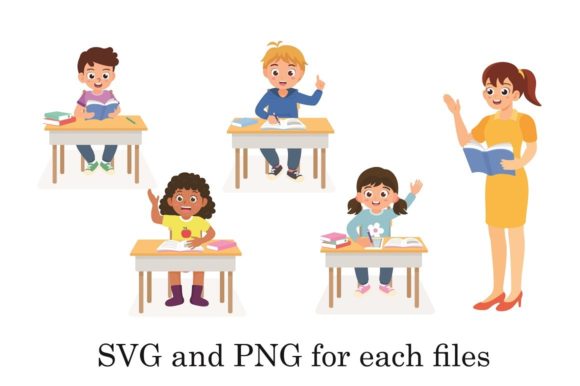
Back to School Teacher Student: A Versatile Graphic Set for Your Creative Workflow
Whether you are a small business owner preparing a seasonal product line, a teacher designing classroom materials, or a hobbyist looking to personalize gifts, having the right digital assets can make the difference between a project that feels rushed and one that looks polished. The Back to School Teacher Student graphic set offers exactly that kind of foundational resource. It includes seven separate elements: one teacher figure, four students, a desk, and a blackboard, all delivered in both PNG and SVG formats. With transparent backgrounds, a standard 5×5 inch size at 300 dpi, and vector scalability, these files are built to fit smoothly into a wide range of creative and production workflows.
This article walks through what this set contains, how it interacts with common tools and platforms, and practical ways to integrate it into your process before, during, and after a project. The goal is to help you move from download to deployment efficiently, while maintaining consistency and quality across your output.
Understanding the Asset Set and What It Offers
Before you start placing graphics into a design, it helps to know exactly what you are working with. The Back to School Teacher Student set includes seven separate PNG images with transparent backgrounds, each at 5×5 inches with 300 dpi resolution. That resolution is sufficient for both screen use and print applications up to moderate sizes. The set also includes seven separate SVG files, which are vector graphics. Vector files are resolution-independent, meaning you can scale them up to poster size or down to a small sticker without losing edge clarity.
The specific characters and objects in the set are designed to represent a typical classroom scene: a teacher, four students (likely with varied poses or appearances), a desk, and a blackboard. Having these as individual elements rather than a single composite image gives you flexibility. You can arrange them, resize each one independently, layer them, or use only the pieces that fit your current project. This modular approach is especially useful when you need to create variations of a design for different products or contexts.
The SVG files are explicitly labeled as compatible with Cricut and Silhouette machines, which is important if you work with physical cutting, vinyl, or iron-on transfers. The PNG files, meanwhile, are ready for immediate use in mockups, digital presentations, or print-on-demand platforms that work best with raster images.
Where This Set Fits in a Broader Workflow
The Back to School Teacher Student graphics can serve different roles depending on when you introduce them into your process. Understanding these phases helps you plan ahead and avoid rework.
Before the Project: Planning and Preparation
When you are mapping out a product line, a seasonal promotion, or a set of classroom materials, having a consistent visual theme saves time. This set provides that theme directly. Instead of sourcing individual illustrations from multiple vendors with different styles, you get a cohesive set of characters and props. You can use the SVG files during the planning phase to create quick mockups of t-shirt layouts, sticker sheets, or party decorations. Because vectors are easy to duplicate and resize, you can experiment with composition without committing to a final print resolution.
If you are a print-on-demand seller, you might also use the PNG files to test color variations against your store’s branding. Drop the transparent images into a mockup template, adjust the scale, and see how the classroom theme looks on a mug or a tote bag. The 5×5 inch base size approximates a typical central graphic area, so you can quickly gauge proportions.
During the Project: Active Design and Production
Once you move into the execution phase, the Back to School Teacher Student assets become part of your active toolkit. Open the SVG files in a vector editing application like Adobe Illustrator, Inkscape, or Affinity Designer. Because each element is a separate file, you can import only the ones you need and begin arranging them on your artboard. The blackboard, for example, can serve as a background element with the teacher standing beside it, while the four students are placed in the foreground. You can change colors of individual vector shapes if the default palette needs adjustment for your product line.
For Cricut or Silhouette users, the SVG files load directly into the design space software. The transparent background and clean vector paths mean you can send the teacher or student silhouettes to the cutting mat without needing to clean up stray elements. This is where the set’s compatibility shines: you can produce vinyl decals, iron-on transfers for t-shirts, or even layered paper cutouts for bulletin boards or scrapbook pages.
If your work involves digital printing rather than cutting, the PNG files are equally efficient. Drop them into Canva, Photoshop, or a print-layout program like Scribus. The 300 dpi resolution ensures that when you print at 5×5 inches or slightly larger, the image remains sharp. For larger applications, use the SVG to export a larger PNG at the exact size you need.
After the Project: Archiving, Reusing, and Repurposing
One often overlooked part of the workflow is what happens after the initial project is delivered. The Back to School Teacher Student set, being modular and vector-based, lends itself well to reuse. Archive the SVG files in a clearly named folder so you can retrieve them for next year’s back-to-school promotions or for a different classroom theme. Because the files are not tied to a specific layout, you can combine them with other graphic sets, change the arrangement, or use only two or three elements for a smaller project.
If you are an educator creating resources for different grade levels, the set can be used repeatedly: one week the teacher figure appears on a worksheet, the next week the blackboard graphic becomes part of a digital reward chart. The consistent style across all seven files helps maintain a unified look even when used across multiple documents.
Practical Implementation Tips
To get the most out of the Back to School Teacher Student set, consider a few practical points before you start designing.
- Check file naming and organization. When you unzip the folder, you will likely see seven PNG files and seven SVG files. Rename them with descriptive labels (e.g., teacher_figure.svg, student_1.svg, blackboard.svg) if they aren’t already clear. This saves time when you are selecting files for a project later.
- Set up a master design template. If you plan to use these graphics repeatedly—for instance, on t-shirts, stickers, and mugs—create a template file in your design software. Import all seven SVGs into a library or a single document with separate layers. Then duplicate that file for each new project. This keeps your base assets ready and reduces repetitive importing.
- Scale with intention. The 5×5 inch base size is a reference. For a sticker, that size might be perfect. For a t-shirt, you might scale the teacher figure to 8 inches tall. Because the SVGs are vectors, scaling up does not degrade quality. However, if you export from SVG to PNG for a large format print, ensure your export resolution is at least 150 dpi for the final print size.
- Use transparency for layering. Both PNG and SVG formats support transparent backgrounds. Take advantage of that to place the teacher behind the blackboard or to have the desk sitting in front of the students. In print, this allows you to create multi-layer vinyl decals by stacking cutouts in sequence.
Interactions with Other Tools and Platforms
The Back to School Teacher Student set is designed to be platform-agnostic, but its value increases when you pair it with the right applications. For Cricut Design Space, the SVG files import as clean cut paths. The blackboard element, for example, can be cut as a single piece of vinyl, while the teacher figure might be cut as a separate color. In Silhouette Studio, the same approach works: assign different colors to different parts of the vector within the software, or use the PNG files as print-and-cut images.
For print-on-demand sellers on platforms like Redbubble, Teespring, or Amazon Merch, the PNG files can be uploaded directly as the primary design. The transparent background is ready for placement on shirts, hoodies, or phone cases. The 5×5 inch size usually fits the maximum print area for most apparel products. If you need to adjust for a different product type, resize the SVG in your design software and export a new PNG at the appropriate dimensions.
If you are a teacher or a blogger creating digital resources for sites like Teachers Pay Teachers, the set works well in slide decks, PDFs, or interactive whiteboard files. The vector format allows you to add the graphics to a PowerPoint or Google Slides presentation, then resize them without pixelation. The four student figures can be used to illustrate group work or to label different areas of a classroom diagram.
Quality Control and Consistency
When using any pre-made graphic set, consistency is key. The Back to School Teacher Student assets share a common illustration style and color palette, which means you can mix and match them freely. However, pay attention to the proportions: the teacher, students, desk, and blackboard should appear relative to each other in a scene. The 5×5 inch base size gives each element a similar footprint, but you may need to scale the desk slightly larger or the students smaller depending on your composition.
For projects that require high-quality print output, always test a sample before running a full batch. Print a small sticker or a single t-shirt transfer to check color accuracy and edge crispness. Because the PNG files are 300 dpi at 5×5 inches, they should reproduce cleanly on most home printers or commercial services. If you notice any jagged edges on a print, verify that you are using the PNG directly without rescaling it in a program that may have resampled the image.
For vector users, verify that the SVG files contain no hidden layers or extra groups that could complicate cutting. Open the SVG in a text editor if necessary—well-formed SVG will have clean path data. Most commercial sets are already optimized, but a quick check can save a wasted sheet of vinyl.
Long-Term Use and Storage
Digital assets like the Back to School Teacher Student set retain their value over time if stored properly. Keep the original zip file in a cloud storage folder, and also extract the files into a dedicated directory on your local drive. For frequent access, import the SVGs into a digital asset management tool or a simple folder hierarchy by project type. Label folders with dates or themes so you can retrieve the specific teacher or student images quickly when a new order or project emerges.
Because the set is designed for recurring seasonal use, consider planning a content calendar around back-to-school periods. In July or August, use the teacher and blackboard to promote classroom resources. In September, use the students for first-day-of-school stickers. The same set can support multiple campaigns without additional design cost, which is especially valuable for small businesses and freelancers who operate on tight budgets.
If you share your designs with a team or with clients, the transparent PNG files are easy to drop into collaborative tools like Frame.io, Google Docs, or presentation software. The SVG files can be embedded into wireframes or mockups for client approval before production begins. This eliminates the back-and-forth of file conversion and ensures everyone sees the same version.
Ultimately, the utility of the Back to School Teacher Student graphics lies in their simplicity and modularity. They are not a complete design solution on their own, but they serve as reliable building blocks for a wide range of print, digital, and physical products. By integrating them thoughtfully into your planning, execution, and archival workflow, you can reduce creative friction and deliver consistent results across multiple projects.